Atezolizumab PK: baseline patient profiles
Compare circulating atezolizumab exposure under fixed patient covariates and constant clearance. The released two-compartment model includes intravenous infusions and cumulative exposure.
Real-World Pharmacokinetics, Effectiveness, and Safety of Atezolizumab in Patients With Unresectable Advanced or Recurrent NSCLC: An Exploratory Study of J-TAIL ↗JTO Clinical and Research Reports
Exploration notes · What are you exploring?
Notes stay on this browser.
MODEL IN MOTION 18 sec
How do the declared sex and ADA contexts change atezolizumab exposure?
Two 1200 mg q3w infusions at fixed reference covariates
Fixed circulating-PK example with supplied covariates, individual coordinates and explicit central mg infusions; no original patient or cohort reconstruction.
Inputs changed since the displayed result. Run to update the comparison.
Biology
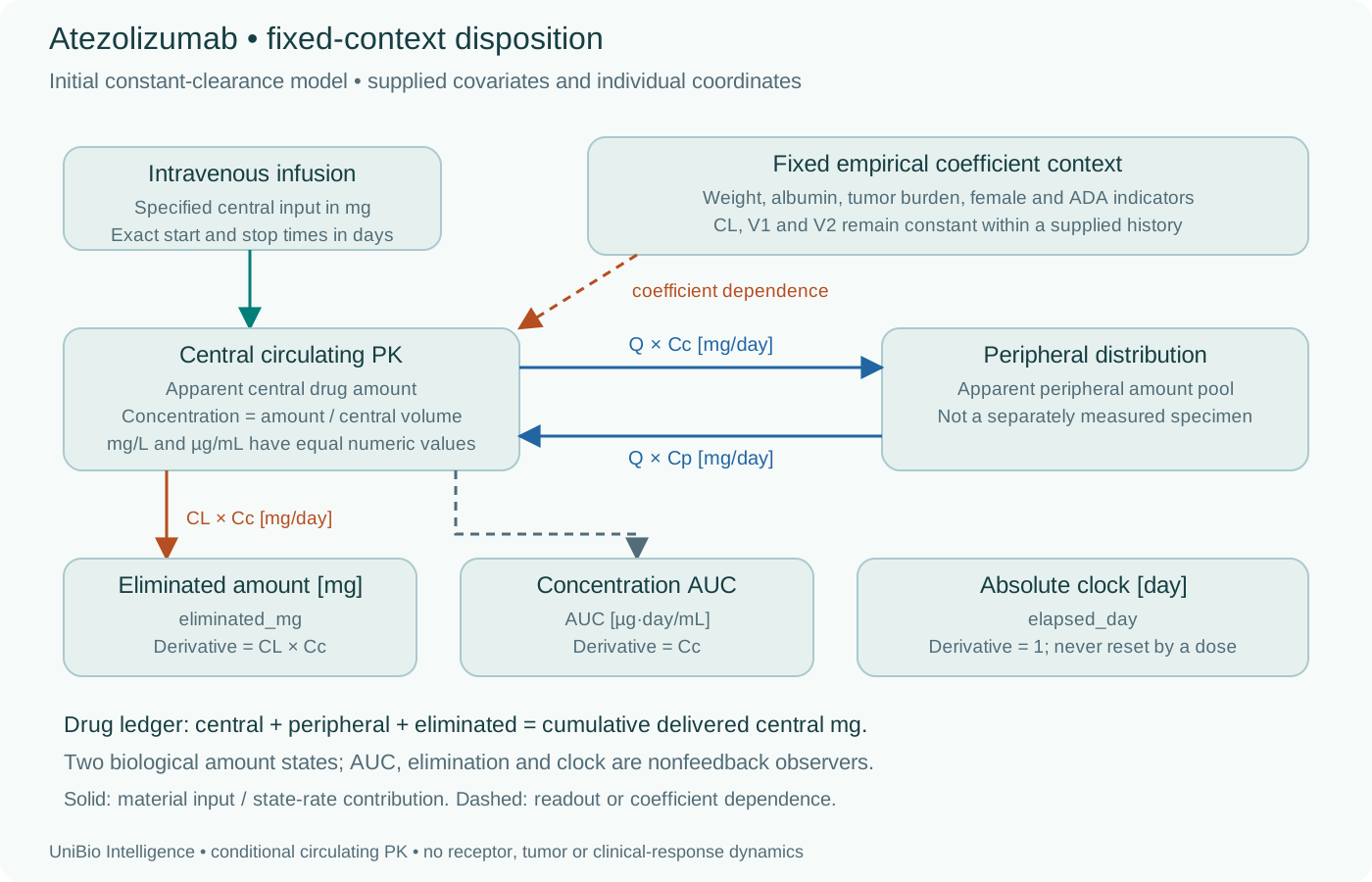
Initial constant-clearance two-compartment atezolizumab disposition under fixed covariates, with explicit central infusions, cumulative exposure and physical drug accounting.
Model details
25 parameters · 5 states · 5 equations · 20 derived outputs
Classification & API access
- Therapeutic
- Atezolizumab
- Modality
- Monoclonal antibody
- Target
- PD-L1 / CD274
- Disease / scope
- Advanced or recurrent non-small cell lung cancer
| Parameter | Default | Unit | Description |
|---|---|---|---|
Population systemic clearanceCL_pop_L_day | 0.2 | L/day | Population systemic clearance governing removal of modeled material from the relevant compartment. |
Population intercompartmental clearanceQ_pop_L_day | 0.546 | L/day | Population intercompartmental clearance governing exchange between model compartments. |
Population central distribution volumeV1_pop_L | 3.28 | L | Population central distribution volume used to convert modeled amount to concentration in the relevant compartment. |
Population peripheral distribution volumeV2_pop_L | 3.63 | L | Population peripheral distribution volume used to convert modeled amount to concentration in the relevant compartment. |
Serum albuminalbumin_g_L | 39 | g/L | Serum albumin used by this model. |
Albumin reference galbumin_reference_g_L | 40 | g/L | Albumin reference g coefficient used by the released system of model equations. |
Atag positiveatag_positive | 0 | — | Atag positive coefficient used by the released system of model equations. |
Body weightbody_weight_kg | 58.6 | kg | Body weight used for body-size scaling in the model. |
Body weight referencebody_weight_reference_kg | 77 | kg | Body weight reference used for body-size scaling in the model. |
Eta clearanceeta_cl | 0 | — | Eta clearance governing removal of modeled material from the relevant compartment. |
Eta distribution volume 1eta_v1 | 0 | — | Eta distribution volume 1 used to convert modeled amount to concentration in the relevant compartment. |
Eta distribution volume 2eta_v2 | 0 | — | Eta distribution volume 2 used to convert modeled amount to concentration in the relevant compartment. |
Source additive residual variancefda_residual_additive_variance_ug_ml2 | 16.6 | µg²/mL² | FDA Table6 sigma-squared value; no observation noise or likelihood is generated. |
Source proportional residual variancefda_residual_proportional_variance | 0.0433 | — | FDA Table6 sigma-squared value; used only for a named observation-SD diagnostic, no noise draw. |
Femalefemale | 0 | — | Female coefficient used by the released system of model equations. |
Typical albumin clearancetheta_albumin_CL | -1.12 | — | Typical albumin clearance governing removal of modeled material from the relevant compartment. |
Typical albumin distribution volume 1theta_albumin_V1 | -0.35 | — | Typical albumin distribution volume 1 used to convert modeled amount to concentration in the relevant compartment. |
Typical atag clearancetheta_atag_CL | 0.159 | — | Typical atag clearance governing removal of modeled material from the relevant compartment. |
Typical body weight clearancetheta_body_weight_CL | 0.808 | — | Typical body weight clearance used for body-size scaling in the model. |
Typical body weight distribution volume 1theta_body_weight_V1 | 0.559 | — | Typical body weight distribution volume 1 used for body-size scaling in the model. |
Typical female distribution volume 1theta_female_V1 | -0.129 | — | Typical female distribution volume 1 used to convert modeled amount to concentration in the relevant compartment. |
Typical female distribution volume 2theta_female_V2 | -0.272 | — | Typical female distribution volume 2 used to convert modeled amount to concentration in the relevant compartment. |
Typical tumor burden clearancetheta_tumor_burden_CL | 0.125 | — | Typical tumor burden clearance governing removal of modeled material from the relevant compartment. |
Tumor burden mmtumor_burden_mm | 43.9 | mm | Tumor burden mm coefficient used by the released system of model equations. |
Tumor burden reference mmtumor_burden_reference_mm | 63 | mm | Tumor burden reference mm coefficient used by the released system of model equations. |
Related models
Feedback: helpdesk@unibiointelligence.com.
