Target-Gated Cargo QSP
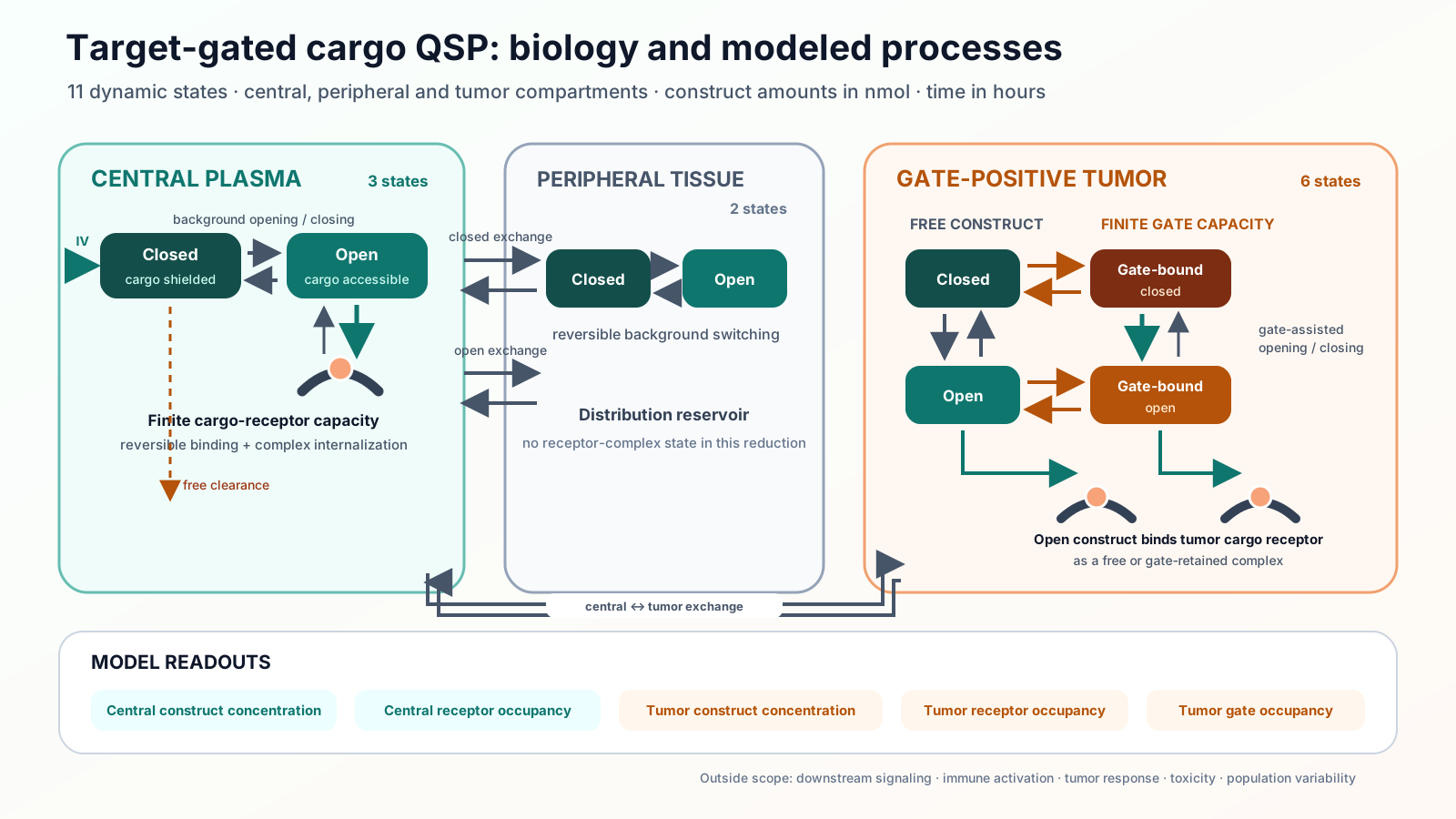
Mechanistic QSP model for an intravenously dosed biologic designed to remain closed systemically and open after engaging a tumor-enriched gate. It connects three-compartment disposition, reversible cargo accessibility, tumor retention, and central-versus-tumor receptor occupancy using transparent UBI-authored equations and synthetic exploratory assumptions.
Exploration notes · What are you exploring?
Notes stay on this browser.
No starting example is available for this configuration.
Biology
Explores how systemic closure, tumor-gate abundance and affinity, gate-assisted opening, tumor retention, cargo-receptor affinity, and dose combine to create a local-versus-systemic receptor-occupancy window.
Assumptions & evidence
Assumptions & limitations
- No paper-specific numerical comparator is distributed or executed.
- No external or UBI experimental dataset has calibrated the nominal parameters.
- Directional similarity to a restricted paper is mechanism-consistency evidence, not reproduction.
- The 30 nmol amount is a neutral exploratory perturbation, not a clinical dose.
- All values are synthetic and uncalibrated.
- Directional similarity to another model is not paper reproduction.
- The zero-gate control is a mechanism-isolation experiment, not a target-negative patient prediction.
- This is an assumed engineering perturbation, not an experimentally achieved molecule.
- This is an assumed mechanism stress test, not a measured construct.
- A receptor-association change may also alter pharmacology not represented by occupancy alone.
Parameter origins
- UBI synthetic exploratory assumption; target identity is intentionally unspecified
- UBI synthetic exploratory assumption; intended for replacement by construct PK data
- UBI synthetic exploratory assumption; intended for replacement by biodistribution data
- UBI synthetic exploratory assumption
- UBI synthetic exploratory assumption; collapses any microscopic gate-coupling steps into one effective rate
- UBI synthetic exploratory assumption; not copied from an IL-12 receptor table
- UBI synthetic exploratory assumption; not estimated from Kahn et al. 2026
Validation & references
Internal invariants, mass-balance checks, directional controls, and governed scenario and parameter-scan qualification passed. No external calibration dataset has yet been attached.
No reference paper is attached to this model.
Model details
21 parameters · 11 states · 11 equations · 19 derived outputs
Classification & API access
- Therapeutic
- generic target-gated cargo
- Modality
- Other biologic or therapeutic modality
- Target
- configurable tumor gate target, configurable cargo receptor
- Disease / scope
- Solid tumors with an accessible tumor-enriched gate target
| Parameter | Default | Unit | Description |
|---|---|---|---|
Accessible tumor gate target capacitygate_capacity_tumor_nmol | 0.15 | nmol | Total accessible binding capacity of the generic tumor-enriched gate target. |
Central peripheral exchange clearanceintercompartmental_clearance_peripheral_L_h | 0.012 | L/h | Symmetric concentration-driven exchange clearance between central and peripheral spaces. |
Central tumor exchange clearanceintercompartmental_clearance_tumor_L_h | 0.00002 | L/h | Symmetric concentration-driven exchange clearance between central plasma and accessible tumor space. |
Background closing ratek_close_background_h | 0.25 | 1/h | First-order closing rate when construct is not bound to tumor gate target. |
Gate bound closing ratek_close_gate_bound_h | 0.03 | 1/h | Effective closing rate while construct remains gate-bound. |
Cargo receptor complex internalizationk_internalize_receptor_complex_h | 0.06 | 1/h | Effective loss rate for receptor-engaged construct; receptor capacity is assumed homeostatically replenished. |
Gate bound construct lossk_loss_gate_bound_h | 0.002 | 1/h | Slow effective loss of gate-bound construct; gate-target capacity is assumed replenished. |
Background opening ratek_open_background_h | 0.004 | 1/h | First-order opening rate when construct is not bound to tumor gate target. |
Gate assisted opening ratek_open_gate_bound_h | 0.3 | 1/h | Effective opening rate after construct binds the tumor gate target. |
Cargo receptor dissociationkoff_cargo_receptor_h | 0.25 | 1/h | Dissociation rate shared by central and tumor cargo-receptor complexes. |
Closed construct gate dissociationkoff_gate_closed_h | 0.25 | 1/h | Dissociation rate of gate-bound closed construct. |
Open construct gate dissociationkoff_gate_open_h | 0.03 | 1/h | Dissociation rate of gate-bound open construct. |
Cargo receptor associationkon_cargo_receptor_per_nM_h | 0.4 | 1/(nM*h) | Association rate shared by free-open and gate-retained open construct. |
Closed construct gate associationkon_gate_closed_per_nM_h | 0.08 | 1/(nM*h) | Association rate between closed construct and free tumor gate target. |
Open construct gate associationkon_gate_open_per_nM_h | 0.12 | 1/(nM*h) | Association rate between open construct and free tumor gate target. |
Central cargo receptor capacityreceptor_capacity_central_nmol | 0.015 | nmol | Homeostatically maintained central capacity available for cargo engagement. |
Tumor cargo receptor capacityreceptor_capacity_tumor_nmol | 0.0015 | nmol | Homeostatically maintained tumor capacity available for cargo engagement. |
Central construct clearancesystemic_clearance_L_h | 0.005 | L/h | Linear clearance applied to free closed and open central construct. |
Central plasma volumevolume_central_L | 3.5 | L | Nominal adult central volume used for exploratory concentration conversion. |
Peripheral accessible volumevolume_peripheral_L | 10.5 | L | Nominal accessible peripheral volume. |
Tumor extracellular accessible volumevolume_tumor_L | 0.004 | L | Nominal accessible tumor extracellular volume. |
Related models
Feedback: helpdesk@unibiointelligence.com.