Bispecific exposure and ternary binding
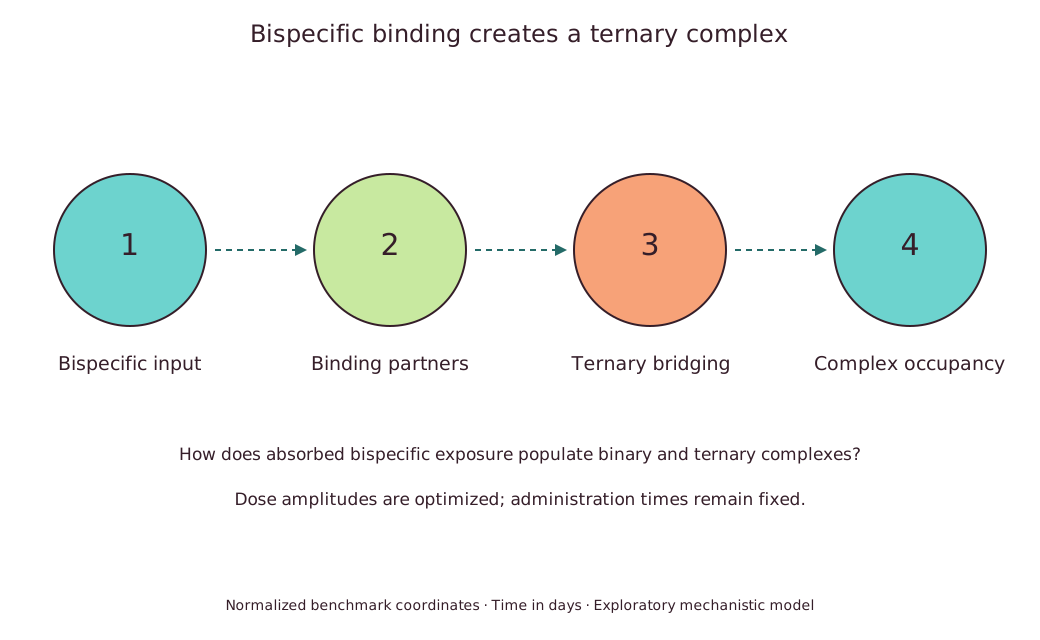
How does absorbed bispecific exposure populate binary and ternary complexes? Explore fixed regimens and bounded dose-amplitude optimization in normalized benchmark units. No clinical dose, patient prediction, global optimum, or paper-figure agreement is claimed.
Exploration notes · What are you exploring?
Notes stay on this browser.
No starting example is available for this configuration.
Optimize dose amplitudes
Administration times and model parameters stay fixed. Adjust starting amplitudes within the declared bounds, then compare the optimized response with the target.
Fixed-time benchmark amplitude optimization; not a clinical regimen or a paper-optimum reproduction.
Sign in to preview and run dose optimization.
Biology
How does absorbed bispecific exposure populate binary and ternary complexes?
Assumptions & evidence
Assumptions & limitations
- Explore fixed regimens and bounded dose-amplitude optimization in normalized benchmark units. No clinical dose, patient prediction, global optimum, or paper-figure agreement is claimed.
Parameter origins
- https://github.com/Craig-Lab/DiffDose/tree/f6c39363bdd127282a555121cbe072c49dd5f276/BiTE.py (make_params, initial_state, forward RHS)
Validation & references
One or more implementation checks are available; this is not a claim of full model reproduction.
No reference paper is attached to this model.
Model details
20 parameters · 8 states · 8 equations · 5 derived outputs
Classification & API access
- Therapeutic
- generic bispecific ligand
- Modality
- Bispecific antibody / T-cell engager
- Target
- generic binding partner A, generic binding partner B
- Disease / scope
- Mechanism-agnostic bispecific binding research
| Parameter | Default | Unit | Description |
|---|---|---|---|
Apparent distribution volumeV | 3 | dimensionless | Benchmark volume ratio |
K12k12 | 0 | 1/day | k12 |
K21k21 | 0.03 | 1/day | k21 |
Absorption rate constantka | 0.2 | 1/day | Absorption rate |
Degradation rate akdegA | 0.1 | 1/day | kdegA |
Degradation rate bkdegB | 0.1 | 1/day | kdegB |
Elimination rate constantkel | 0.1 | 1/day | Drug elimination rate |
Kint akintA | 0.05 | 1/day | kintA |
Ternary complex internalization ratekintAB | 0.1 | 1/day | Ternary-complex internalization rate |
Kint bkintB | 0.05 | 1/day | kintB |
KOFF1koff1 | 0.01 | 1/day | koff1 |
KOFF2koff2 | 0.01 | 1/day | koff2 |
KOFF3koff3 | 0.01 | 1/day | koff3 |
KOFF4koff4 | 0.01 | 1/day | koff4 |
KON1kon1 | 10 | 1/day | kon1 |
KON2kon2 | 1 | 1/day | kon2 |
KON3kon3 | 1 | 1/day | kon3 |
KON4kon4 | 10 | 1/day | kon4 |
Ksyn aksynA | 1 | 1/day | ksynA |
Ksyn bksynB | 10 | 1/day | ksynB |
Related models
Feedback: helpdesk@unibiointelligence.com.