Anakinra exposure and conditional CRP turnover
Apparent subcutaneous anakinra exposure inhibits empirical CRP production. Fixed responder and waning-sensitivity groups distinguish sustained suppression from rebound under a constant or PK-derived concentration driver.
Anakinra pharmacokinetics in children and adolescents with systemic-onset juvenile idiopathic arthritis and autoinflammatory syndromes ↗Exploration notes · What are you exploring?
Notes stay on this browser.
10 kg, 2 mg/kg/day apparent SC
How does bodyweight-projected apparent SC exposure change under a fixed daily administered dose?
Biology
Apparent subcutaneous anakinra exposure inhibits empirical CRP production. Fixed responder and waning-sensitivity groups distinguish sustained suppression from rebound under a constant or PK-derived concentration driver.
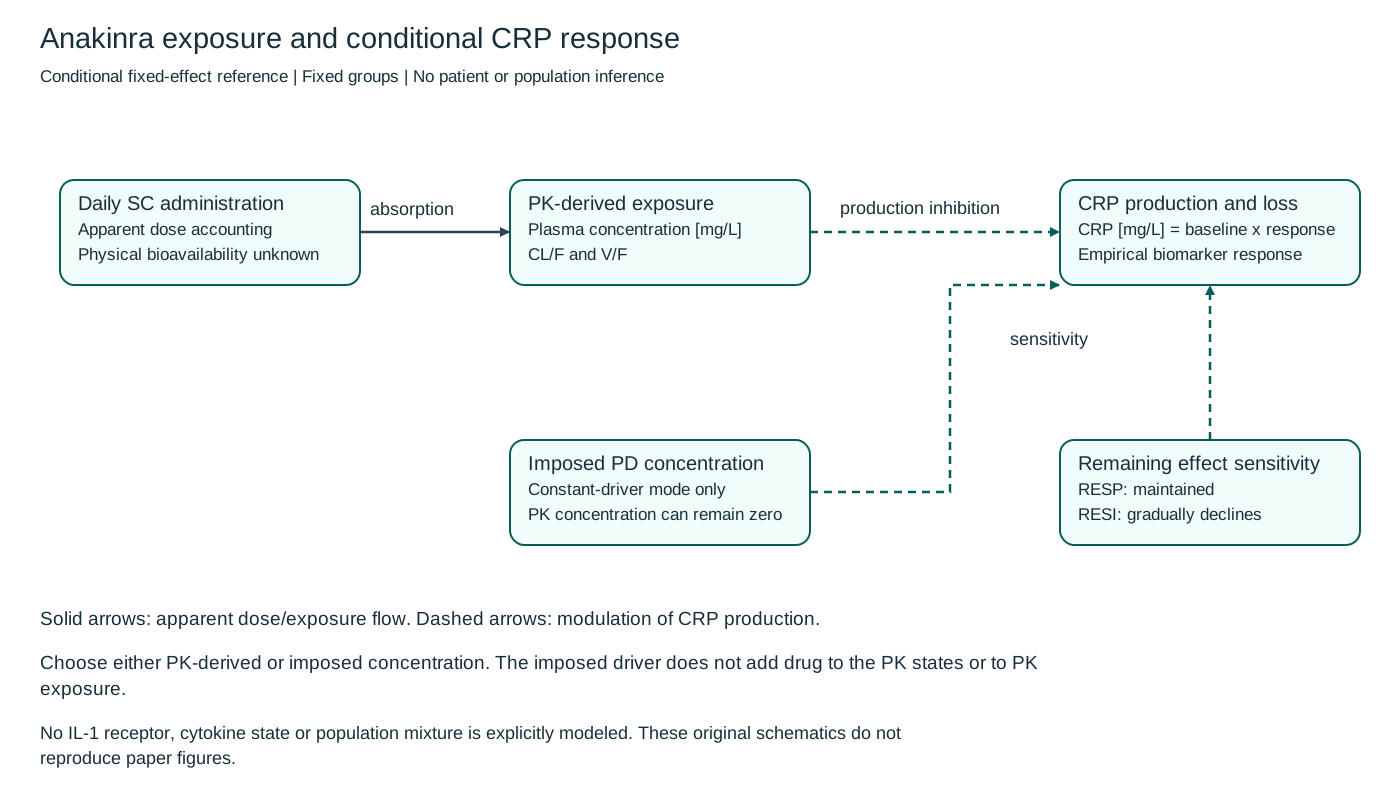
States & equation dependencies
Assumptions & evidence
Assumptions & limitations
- Conditional fixed-effect exploration only; no clinical dose recommendations, individual patient inference, original fit or population prediction.
- Clearance and volume are apparent CL/F and V/F. Unknown physical bioavailability is not identified by the unit dose multiplier or apparent amount ledger.
- High-baseline and lower-baseline contexts are fixed conditional groups, not estimated mixture probabilities. Remaining effect sensitivity declines in the waning context; it is not resistance prevalence.
- Imposed-concentration contexts drive CRP externally. They do not produce PK concentration or PK exposure without administrations. Clearance and absorption controls are relevant to SC contexts; imposed concentration is relevant only to imposed-driver contexts.
- Clearance bounds span retained bodyweight-projected values, but changing clearance alone is not a bodyweight projection. Absorption and turnover ranges are authored 0.5–1.5× default perturbations. Sensitivity-loss bounds span zero to 1.5× the source RESI rate. The imposed-concentration interval spans the source Figure 3 settings and zero. None is a clinical or uncertainty interval.
- Bodyweight is resolved into each starting configuration. Dose amounts and volume stay fixed when clearance is edited; choosing a different configuration changes the jointly authored context.
- The source between-occasion volume variability, patient observations, BLQ/log10 likelihood, mixed-effects fit and prediction intervals are not reproduced.
- No complete source figure panel is reproduced. Rounded Table 1 versus prose coefficients, literal Table 2 uncertainty entries and the reported group proportions remain source limitations.
- Changing the start resets the supplied initial states; earlier administrations are not reconstructed. Dose-event observations retain their declared pre/post side.
- Long coupled histories are mechanistic diagnostics and do not establish observed long-term clinical behavior.
Parameter origins
- Released executable model definition; exact publication locator not reported
Validation & references
One or more implementation checks are available; this is not a claim of full model reproduction.
Anakinra pharmacokinetics in children and adolescents with systemic-onset juvenile idiopathic arthritis and autoinflammatory syndromes ↗Available reference curves can be added to the plot when their scenario, readout, time and units match.
Model details
9 parameters · 6 states · 6 equations · 9 derived outputs
Classification & API access
- Therapeutic
- anakinra
- Modality
- Other biologic or therapeutic modality
- Target
- IL1R1
- Disease / scope
- systemic juvenile idiopathic arthritis, autoinflammatory syndromes
| Parameter | Default | Unit | Description |
|---|---|---|---|
Baselinebaseline | 141 | mg/L | Fixed group baseline CRP, not fitted individual baseline. Envelope covers frozen private cases, not public scan or fitting bounds. |
C50c50 | 0.03 | mg/L | Concentration for half initial inhibition of CRP production. Envelope covers frozen private cases, not public scan or fitting bounds. |
Systemic clearancecl | 6.24 | L/h | Apparent clearance CL/F, projected from source bodyweight; physical bioavailability unknown. Exploratory control; interpretation depends on the selected context. |
Imposed PD concentrationconstant_c | 0 | mg/L | Externally imposed PD concentration only when mode is one. Exploratory control; interpretation depends on the selected context. |
Absorption rate constantka | 0.38 | 1/h | First-order SC absorption rate. Exploratory control; interpretation depends on the selected context. |
Loss of effect sensitivitykresi | 0 | 1/h | Decay rate of remaining drug-effect sensitivity; zero for RESP and 0.0048/day for RESI. Exploratory control; interpretation depends on the selected context. |
Crp turnover ratektr | 0.00175 | 1/h | Empirical CRP turnover rate, converted from day to hour. Exploratory control; interpretation depends on the selected context. |
Modemode | 0 | 1 | Fixed diagnostic switch: zero uses PK-derived concentration, one supplies constant_c. Intermediate mixtures are unqualified. Envelope covers frozen private cases, not public scan or fitting bounds. |
Central distribution volumevc | 65.2 | L | Apparent volume V/F, projected from source bodyweight; physical distribution volume unidentified. Envelope covers frozen private cases, not public scan or fitting bounds. |
Related models
Feedback: helpdesk@unibiointelligence.com.
