Bivalent antibody distribution and tissue occupancy
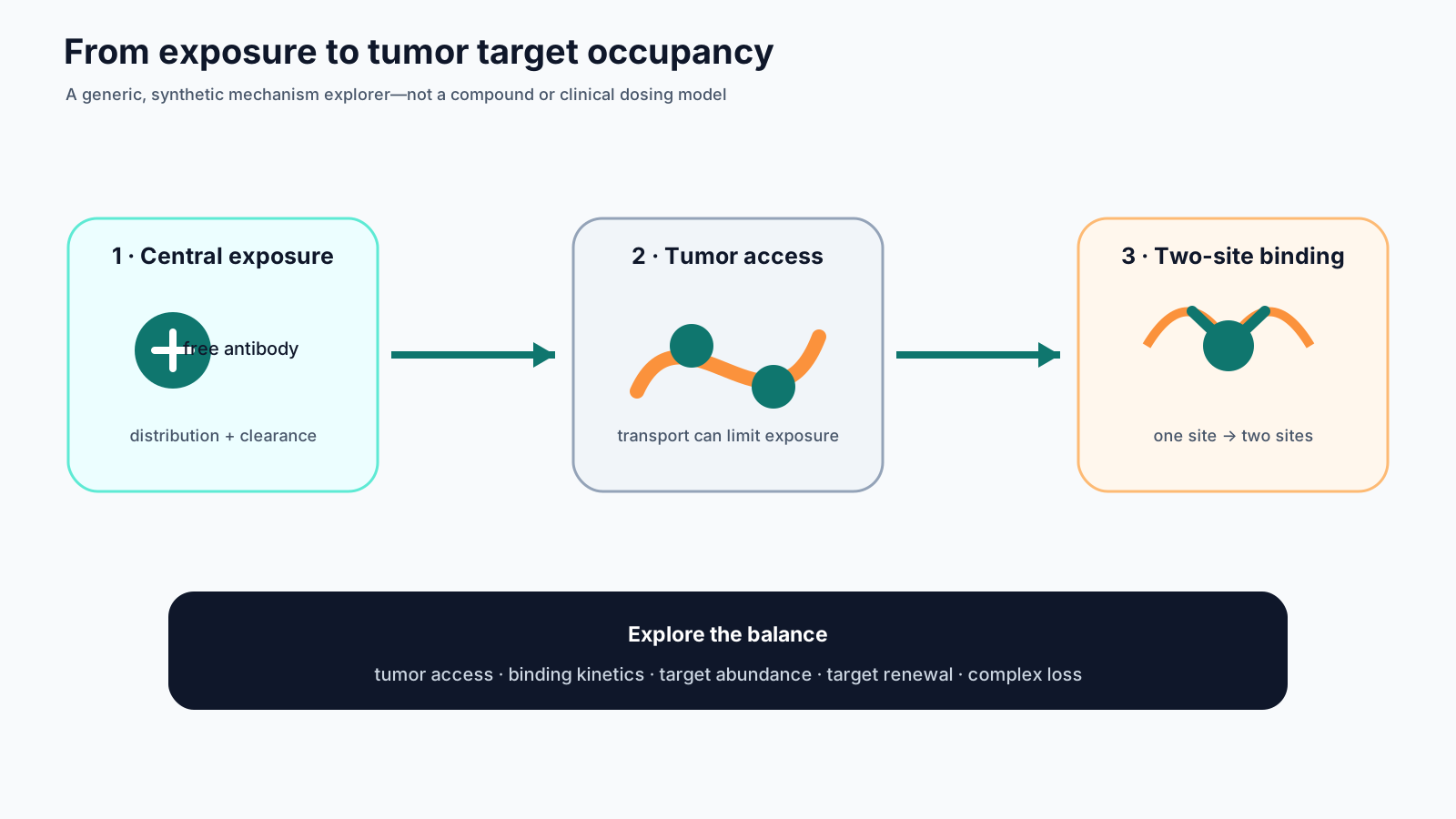
Explore central and tissue antibody exposure and target occupancy using an independently authored nine-state mechanism and explicit synthetic parameter values.
Exploration notes · What are you exploring?
Notes stay on this browser.
Balanced tumor access
A synthetic 30 nmol bolus probes central and tumor occupancy under nominal transport and binding assumptions.
0–480 hour
Inputs changed since the displayed result. Run to update the comparison.
Loading starting example…
Biology
Generic central/peripheral/tissue exchange and sequential two-site binding; all13parameters are synthetic.
Model details
13 parameters · 9 states · 9 equations · 11 derived outputs
Classification & API access
- Therapeutic
- generic bivalent tumor antibody
- Modality
- Monoclonal antibody
- Target
- configurable cell-surface target
- Disease / scope
- Generic solid-tumor target-engagement research
| Parameter | Default | Unit | Description |
|---|---|---|---|
Target association rateassociation_per_nM_h | 0.12 | 1/(nM·h) | Shared synthetic association rate for the first and second target sites. |
Central accessible volumecentral_volume_L | 3 | L | Synthetic central volume for generic mechanism exploration. |
Bound complex losscomplex_loss_h | 0.03 | 1/h | Synthetic loss rate for singly and doubly bound complexes. |
Target dissociation ratedissociation_h | 0.08 | 1/h | Shared synthetic dissociation rate for both binding steps. |
Central peripheral exchange clearanceperipheral_exchange_L_h | 0.03 | L/h | Symmetric concentration-driven exchange clearance. |
Peripheral accessible volumeperipheral_volume_L | 4.5 | L | Synthetic peripheral accessible volume. |
Second site association scalesecond_site_association_scale | 0.6 | — | Synthetic factor allowing the second binding step to differ from the first. |
Systemic antibody clearancesystemic_clearance_L_h | 0.008 | L/h | Linear central clearance of free antibody. |
Central target site baselinetarget_baseline_central_nmol | 0.02 | nmol | Synthetic homeostatic central target-site amount. |
Tumor target site baselinetarget_baseline_tumor_nmol | 0.001 | nmol | Synthetic homeostatic tumor target-site amount. |
Free target turnovertarget_turnover_h | 0.05 | 1/h | Synthetic first-order target turnover shared by central and tumor spaces. |
Central tumor exchange clearancetumor_exchange_L_h | 0.00008 | L/h | Synthetic tumor-access clearance used as the principal distribution control. |
Tumor accessible volumetumor_volume_L | 0.02 | L | Synthetic accessible tumor volume, not a patient tumor measurement. |
Related models
Feedback: helpdesk@unibiointelligence.com.
