Bevacizumab total-serum exposure
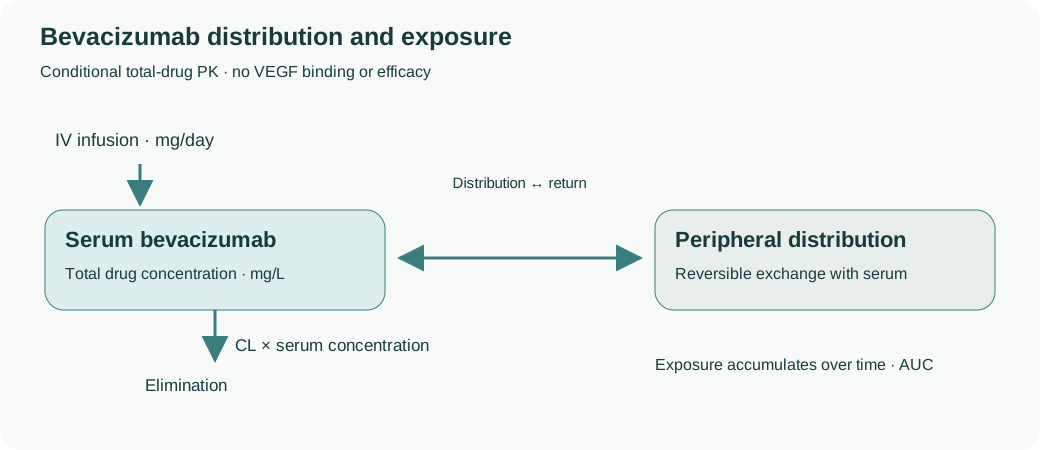
Intravenous bevacizumab distributes between serum and a peripheral compartment and undergoes linear elimination. The independent PK-only parameter set supports conditional total-drug concentration and exposure exploration.
A pharmacokinetic binding model for bevacizumab and VEGF165 in colorectal cancer patients ↗Exploration notes · What are you exploring?
Notes stay on this browser.
5 mg/kg every 2 weeks · 90 then 60 minutes
Independent Table 3 PK-only final fit. Typical fixed effects; no original patients, variability or observation noise. First infusion 90 min, subsequent 60 min; conditional Methods schedule, not known patient histories. Figure 3 is generated by the TMDD model and is not a PK-only validation target.
Biology
Intravenous bevacizumab distributes between serum and a peripheral compartment and undergoes linear elimination. The independent PK-only parameter set supports conditional total-drug concentration and exposure exploration.
States & equation dependencies
Assumptions & evidence
Assumptions & limitations
- Conditional deterministic total-serum bevacizumab PK only. No VEGF binding, free-drug separation, efficacy, safety, individual patient inference or clinical dosing recommendation.
- This is the independently fitted PK-only Table 3 model, not the Table 3 TMDD fit or the source Figure 3 binding-model curves.
- The 19-patient population fit, random effects, 24% proportional residual error, original dosing histories and supplemental goodness-of-fit panels are not reproduced.
- Q and peripheral volume have source relative standard errors of 146% and 50%. Exploratory 0.5–1.5× parameter ranges are not confidence intervals.
- Bodyweight jointly scales CL and Q with exponent 0.75 and volumes with exponent 1.0. Weight is fixed by each starting configuration. Disposition controls do not change administered doses.
- Visible histories use first 90-minute then 60- or 30-minute infusions. The original 85-minute median-duration approximations remain retained diagnostics, not known patient histories.
- Both compartments represent total drug; free and bound drug are not separated.
- Changing the simulation start resets the supplied initial states and does not reconstruct earlier drug amounts. An overlapping infusion delivers only its remaining portion. AUC integrates from that selected start.
- No complete source figure panel or original estimation has been reproduced. Human scientific review remains pending.
Parameter origins
- Released executable model definition; exact publication locator not reported
Validation & references
One or more implementation checks are available; this is not a claim of full model reproduction.
A pharmacokinetic binding model for bevacizumab and VEGF165 in colorectal cancer patients ↗Available reference curves can be added to the plot when their scenario, readout, time and units match.
Model details
8 parameters · 4 states · 4 equations · 4 derived outputs
Classification & API access
- Therapeutic
- Bevacizumab
- Modality
- Monoclonal antibody
- Target
- VEGFA, VEGF165
- Disease / scope
- adult stage IV colorectal cancer
| Parameter | Default | Unit | Description |
|---|---|---|---|
Systemic clearanceCL_L_day | 0.17 | L/day | Independent Table 3 PK-only estimate at 70 kg. Exploratory 0.5–1.5× range; not a confidence interval. Bodyweight and administered doses remain fixed by the selected configuration. |
Intercompartmental clearanceQ_L_day | 0.36 | L/day | Independent Table 3 PK-only estimate at 70 kg. Exploratory 0.5–1.5× range; not a confidence interval. Bodyweight and administered doses remain fixed by the selected configuration. |
Central distribution volumeV1_L | 3.14 | L | Independent Table 3 PK-only estimate at 70 kg. Exploratory 0.5–1.5× range; not a confidence interval. Bodyweight and administered doses remain fixed by the selected configuration. |
Peripheral distribution volumeV2_L | 2.63 | L | Independent Table 3 PK-only estimate at 70 kg. Exploratory 0.5–1.5× range; not a confidence interval. Bodyweight and administered doses remain fixed by the selected configuration. |
Body weightbody_weight_kg | 70 | kg | Body weight used for body-size scaling in the model. |
Reference body weightreference_weight_kg | 70 | kg | Reference body weight coefficient used by the released system of model equations. |
Fixed allometric exponent on clearancetheta_cl_weight | 0.75 | dimensionless | Fixed allometric exponent on clearance governing removal of modeled material from the relevant compartment. |
Fixed allometric exponent on volumestheta_v_weight | 1 | dimensionless | Fixed allometric exponent on volumes coefficient used by the released system of model equations. |
Related models
Feedback: helpdesk@unibiointelligence.com.
