T-DM1 serum exposure with baseline covariates
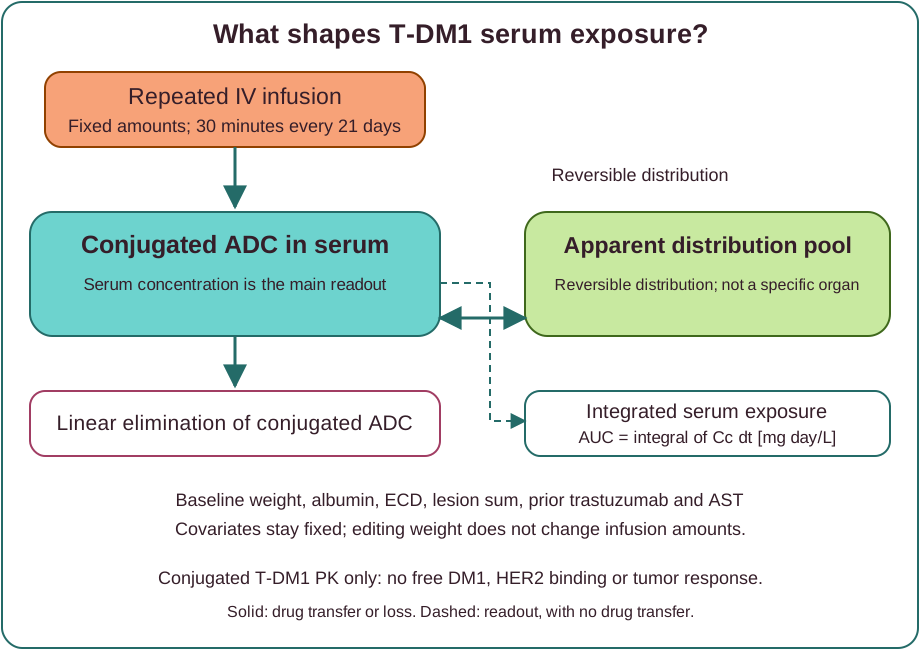
Conditional fixed-effect T-DM1 two-compartment PK with reversible distribution, linear clearance and baseline covariate effects. Predicts serum exposure without payload release, HER2 binding, tumor response or population variability.
Population pharmacokinetics of trastuzumab emtansine (T-DM1), a HER2-targeted antibody–drug conjugate, in patients with HER2-positive metastatic breast cancer: clinical implications of the effect of covariates ↗Exploration notes · What are you exploring?
Notes stay on this browser.
Reference repeated IV exposure
How do fixed covariates and repeated IV input shape typical serum exposure?
Biology
Conditional fixed-effect T-DM1 two-compartment PK with reversible distribution, linear clearance and baseline covariate effects. Predicts serum exposure without payload release, HER2 binding, tumor response or population variability.
States & equation dependencies
Assumptions & evidence
Assumptions & limitations
- Conditional deterministic conjugated T-DM1 PK only; no original patient fit, mixed effects, VPC/NPC, bootstrap, population prediction intervals, payload release, efficacy or safety.
- Printed rounded Table 1 coefficients are retained; Table 2 arithmetic discrepancies remain unresolved and are not acceptance targets.
- Each starting configuration fixes six infusion amounts at 21-day intervals and 0.5-hour durations. Weight edits and scans alter disposition only; they do not recalculate doses. Select a weight-specific starting configuration to use its authored 3.6 mg/kg amounts.
- Covariates remain fixed in time. The 0.5-hour regimen is from the source supplement, without a Figure 3 peak-reproduction claim.
- Cumulative AUC integrates from the selected start. Interval AUC requires endpoint subtraction. The static summary marker carries no drug mass.
- The linear model does not establish low-dose nonlinear behavior, hepatic-impairment effects or clinical validity.
Parameter origins
- Released executable model definition; exact publication locator not reported
Validation & references
One or more implementation checks are available; this is not a claim of full model reproduction.
Population pharmacokinetics of trastuzumab emtansine (T-DM1), a HER2-targeted antibody–drug conjugate, in patients with HER2-positive metastatic breast cancer: clinical implications of the effect of covariates ↗Available reference curves can be added to the plot when their scenario, readout, time and units match.
Model details
28 parameters · 4 states · 4 equations · 6 derived outputs
Classification & API access
- Therapeutic
- Ado-trastuzumab emtansine, trastuzumab
- Modality
- Antibody–drug conjugate (ADC)
- Target
- HER2 / ERBB2
- Disease / scope
- HER2-positive locally advanced or metastatic breast cancer
| Parameter | Default | Unit | Description |
|---|---|---|---|
Reference clearanceCL_ref | 0.676 | L/day | Reference clearance governing removal of modeled material from the relevant compartment. |
Intercompartmental clearanceQ | 1.534 | L/day | Intercompartmental clearance governing exchange between model compartments. |
Reference central volumeVc_ref | 3.127 | L | Reference central volume used to convert modeled amount to concentration in the relevant compartment. |
Peripheral distribution volumeVp | 0.66 | L | Peripheral distribution volume used to convert modeled amount to concentration in the relevant compartment. |
Fixed numerical guard albumin floor galbumin_floor_g_L | 1e-12 | g/L | Original numeric floor expressed with its physical unit; not a biological control. |
Serum albuminalbumin_g_L | 41 | g/L | Serum albumin coefficient used by the released system of model equations. |
Reference serum albuminalbumin_ref_g_L | 41 | g/L | Reference serum albumin coefficient used by the released system of model equations. |
Serum astast_U_L | 27 | U/L | Serum ast coefficient used by the released system of model equations. |
Fixed numerical guard ast floor uast_floor_U_L | 1e-12 | U/L | Original numeric floor expressed with its physical unit; not a biological control. |
Reference serum astast_ref_U_L | 27 | U/L | Reference serum ast coefficient used by the released system of model equations. |
Fixed numerical guard body weight floorbody_weight_floor_kg | 1 | kg | Original numeric floor expressed with its physical unit; not a biological control. |
Body weightbody_weight_kg | 70 | kg | Body weight used for body-size scaling in the model. |
Reference body weightbody_weight_ref_kg | 70 | kg | Reference body weight used for body-size scaling in the model. |
Fixed numerical guard ecd floorecd_floor_ng_mL | 1e-12 | ng/mL | Original numeric floor expressed with its physical unit; not a biological control. |
Baseline HER2 shed extracellular domainecd_ng_mL | 25 | ng/mL | Baseline HER2 shed extracellular domain coefficient used by the released system of model equations. |
Reference HER2 shed extracellular domainecd_ref_ng_mL | 25 | ng/mL | Reference HER2 shed extracellular domain coefficient used by the released system of model equations. |
Fixed eigenvalue discriminant guardeigen_discriminant_floor_day2 | 1e-12 | 1/day^2 | Preserves original numeric floor with inverse-day-squared unit; not a biological control. |
Baseline trastuzumab concentrationtbl_ug_mL | 0 | ug/mL | Baseline trastuzumab concentration coefficient used by the released system of model equations. |
Albumin effect on clearancetheta_cl_albumin | -0.423 | dimensionless | Albumin effect on clearance governing removal of modeled material from the relevant compartment. |
Ast effect on clearancetheta_cl_ast | 0.071 | dimensionless | Ast effect on clearance governing removal of modeled material from the relevant compartment. |
HER2 ecd effect on clearancetheta_cl_ecd | 0.035 | dimensionless | HER2 ecd effect on clearance governing removal of modeled material from the relevant compartment. |
Baseline trastuzumab effect on clearancetheta_cl_tbl | -0.002 | 1/(ug/mL) | Baseline trastuzumab effect on clearance governing removal of modeled material from the relevant compartment. |
Target lesion burden effect on clearancetheta_cl_tmbd | 0.052 | dimensionless | Target lesion burden effect on clearance governing removal of modeled material from the relevant compartment. |
Weight effect on clearancetheta_cl_weight | 0.49 | dimensionless | Weight effect on clearance governing removal of modeled material from the relevant compartment. |
Weight effect on central volumetheta_vc_weight | 0.596 | dimensionless | Weight effect on central volume used to convert modeled amount to concentration in the relevant compartment. |
Baseline sum of longest target lesion dimensionstmbd_cm | 9 | cm | Baseline sum of longest target lesion dimensions coefficient used by the released system of model equations. |
Fixed numerical guard tmbd floor cmtmbd_floor_cm | 1e-12 | cm | Original numeric floor expressed with its physical unit; not a biological control. |
Reference target lesion burdentmbd_ref_cm | 9 | cm | Reference target lesion burden coefficient used by the released system of model equations. |
Related models
Feedback: helpdesk@unibiointelligence.com.
