Rat-brain antibody and target response — reduced companion
Explore local antibody expression, reversible target binding and turnover in three independent concentration systems.
Exploration notes · What are you exploring?
Notes stay on this browser.
MODEL IN MOTION 18 sec
How do the fixed delivery and vector presets change brain antibody and target?
IST 2.5E11 Vg AAV9 — fixed expression profile
Specified fixed initial drivers, local protein/target concentrations and hour calendar; no administered dose events.
0–1,344 hour
Inputs changed since the displayed result. Run to update the comparison.
Loading starting example…
Biology
Explore local antibody expression, reversible target binding and turnover in three independent concentration systems.
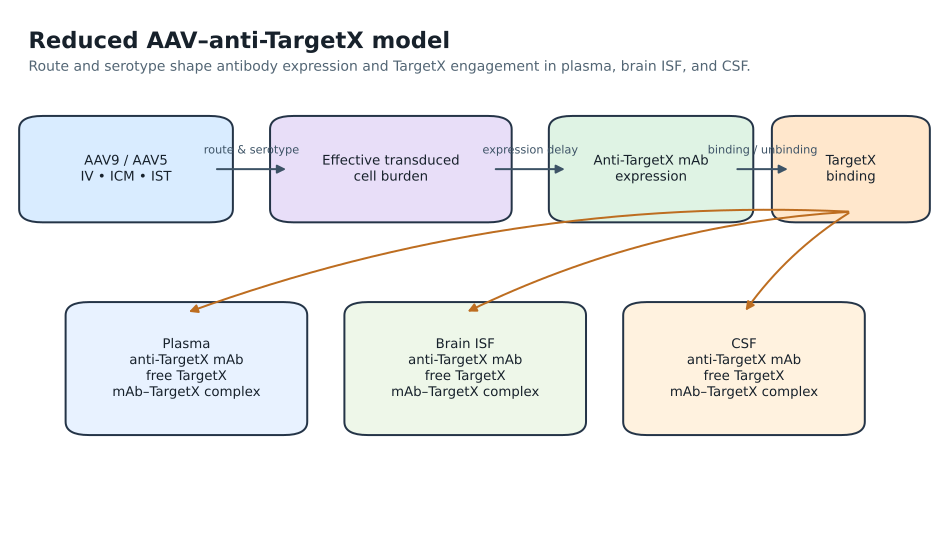
Model details
13 parameters · 31 states · 31 equations · 64 derived outputs
Classification & API access
- Therapeutic
- Anti-TargetX antibody
- Modality
- Monoclonal antibody
- Target
- TargetX (anonymized target)
- Disease / scope
- Exploratory soluble TargetX binding and antibody expression
| Parameter | Default | Unit | Description |
|---|---|---|---|
Durable antibody production ratedurable_mab_production_nM_per_burden_h | 0.66 | nM/h | Fixed input of the declared conditional companion; see parameter provenance and scope. |
Fast antibody production ratefast_mab_production_nM_per_burden_h | 1 | nM/h | Fixed input of the declared conditional companion; see parameter provenance and scope. |
Fast AAV loss ratek_aav_fast_loss_h | 0.0175 | 1/h | Fixed input of the declared conditional companion; see parameter provenance and scope. |
K complex lossk_complex_loss_h | 0.00086 | 1/h | Fixed input of the declared conditional companion; see parameter provenance and scope. |
K mab lossk_mab_loss_h | 0.0006 | 1/h | Fixed input of the declared conditional companion; see parameter provenance and scope. |
Nuclear AAV loss ratek_nuclear_loss_h | 0.00001 | 1/h | Fixed input of the declared conditional companion; see parameter provenance and scope. |
Transgene expression ratek_transgene_h | 0.033003300330033 | 1/h | Fixed input of the declared conditional companion; see parameter provenance and scope. |
Target baseline csftarget_baseline_csf_nM | 0.023 | nM | Fixed input of the declared conditional companion; see parameter provenance and scope. |
Target baseline isftarget_baseline_isf_nM | 0.026 | nM | Fixed input of the declared conditional companion; see parameter provenance and scope. |
Target baseline plasmatarget_baseline_plasma_nM | 0.175 | nM | Fixed input of the declared conditional companion; see parameter provenance and scope. |
Target degradation ratetarget_kdeg_h | 0.49510512897138953 | 1/h | Fixed input of the declared conditional companion; see parameter provenance and scope. |
Target dissociation ratetarget_koff_h | 0.00427 | 1/h | Fixed input of the declared conditional companion; see parameter provenance and scope. |
Target association ratetarget_kon_per_nM_h | 0.05770270270270271 | 1/(nM·h) | Fixed input of the declared conditional companion; see parameter provenance and scope. |
Related models
Feedback: helpdesk@unibiointelligence.com.