Rituximab effect and B-cell recovery in pediatric nephrotic syndrome
Conditional fixed-effect K-PD model of a latent rituximab effect amount and CD19+ B-cell turnover, with source regimens and IgA sensitivity conditions.
Kinetic-pharmacodynamic model to predict post-rituximab B-cell repletion as a predictor of relapse in pediatric idiopathic nephrotic syndrome ↗Exploration notes · What are you exploring?
Notes stay on this browser.
MODEL IN MOTION 18 sec
How does IgA change modeled B-cell recovery?
See the curated scenarios unfold, then explore them yourself.
Explore a scenario
375 mg/m2 x2 weekly
Conditional deterministic K-PD calculation at fixed source estimates; no population intervals or individual relapse prediction.
Biology
Conditional fixed-effect K-PD model of a latent rituximab effect amount and CD19+ B-cell turnover, with source regimens and IgA sensitivity conditions.
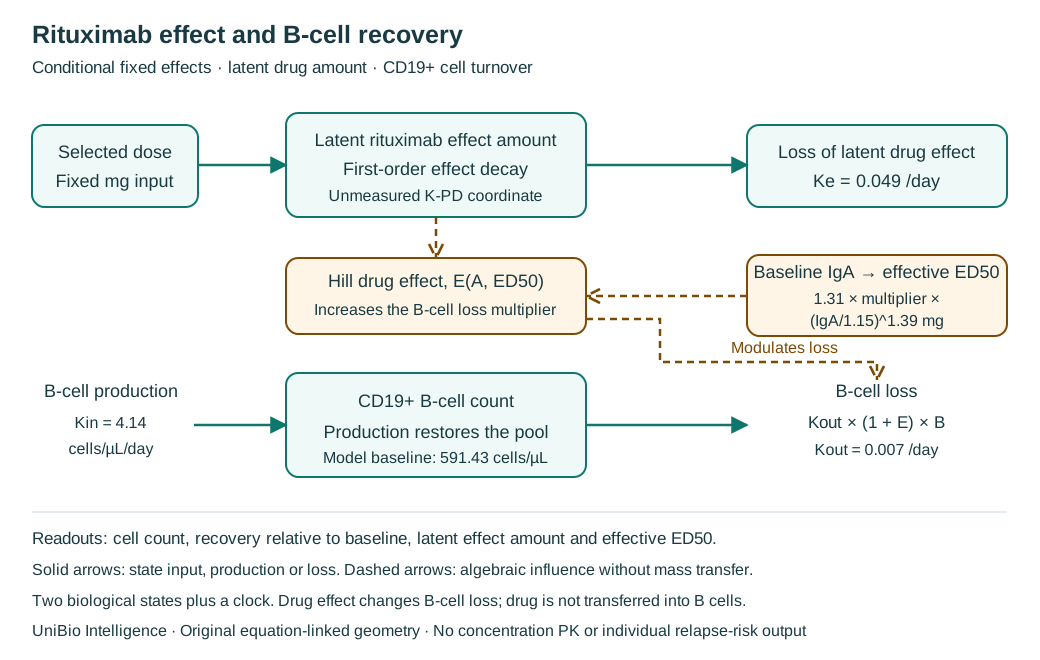
States & equation dependencies
Assumptions & evidence
Assumptions & limitations
- Conditional fixed-effect K-PD calculations; no original population fit, random effects, residual error, prediction intervals or complete paper reproduction.
- A1_mg is a latent rituximab effect amount, not a measured plasma concentration. The model has two biological states plus a separate clock.
- The observed clinical protocol was two weekly IV doses of 375 mg/m2, capped at 500 mg. Presets also include distinct theoretical simulation regimens, including 750 mg/m2; the clinical cap is not applied to those theoretical arms.
- Preset doses are fixed absolute mg derived, where applicable, from BSA 0.82 m2. Editing IgA does not change doses; BSA is inspection-only. Instantaneous latent-amount additions approximate day-scale dosing; infusion durations were not reported.
- Monthly and every-two-month schedules use 30-day and 60-day intervals. These are conditional calendar approximations.
- IgA is the only final fixed-effect covariate. The positive 0.11–2.26 g/L exploration domain comes from the source sensitivity conditions, not a clinically validated range.
- Ten exploratory ED50 conditions retain a different fixed multiplier for each regimen. They are additional conditional calculations, not independent validation or population predictions.
- B-cell repletion means the first upward crossing above 10 cells/uL after depletion, measured from first treatment. Instantaneous cell count or normalized recovery alone does not calculate that event time.
- The separate clinical survival/nomogram analysis is not implemented. No individual relapse probability, concentration PK, clearance, volume or concentration AUC is returned.
- Changing the simulation start applies the supplied initial state there; it does not reconstruct prior doses. Fitting and normal server parameter scans are unavailable.
Parameter origins
- Released executable model definition; exact publication locator not reported
Validation & references
One or more implementation checks are available; this is not a claim of full model reproduction.
Kinetic-pharmacodynamic model to predict post-rituximab B-cell repletion as a predictor of relapse in pediatric idiopathic nephrotic syndrome ↗Available reference curves can be added to the plot when their scenario, readout, time and units match.
Model details
13 parameters · 3 states · 3 equations · 12 derived outputs
Classification & API access
- Therapeutic
- Rituximab
- Modality
- Monoclonal antibody
- Target
- CD20 / MS4A1
- Disease / scope
- Pediatric idiopathic nephrotic syndrome
| Parameter | Default | Unit | Description |
|---|---|---|---|
Half maximal latent effect amountED50_mg | 1.31 | mg | Half maximal latent effect amount coefficient used by the released system of model equations. |
Maximum effectEmax | 389.7 | 1 | Maximum effect defining the limiting magnitude of the corresponding pharmacodynamic effect. |
Latent effect amount decay rateKe_day | 0.049 | 1/day | Latent effect amount decay rate coefficient used by the released system of model equations. |
Zero order b cell productionKin_cells_ul_day | 4.14 | cells/uL/day | Zero order b cell production coefficient used by the released system of model equations. |
Turnover loss rateKout_day | 0.007 | 1/day | Turnover loss rate governing loss, degradation, or removal in the modeled biological process. |
B cell repletion thresholdbcell_repletion_threshold_cells_ul | 10 | cells/uL | B cell repletion threshold coefficient used by the released system of model equations. |
Body surface areabsa_m2 | 0.82 | m^2 | Reference body surface area used to derive fixed absolute preset doses. Inspection-only; changing IgA does not change administered doses. |
Fixed exploratory ED50 multipliered50_calibration_factor | 1 | 1 | Fixed exploratory ED50 multiplier coefficient used by the released system of model equations. |
Hill coefficienthill_gamma | 6.65 | 1 | Hill coefficient coefficient used by the released system of model equations. |
Baseline ig a covariateiga_g_l | 1.15 | g/L | Baseline ig a covariate coefficient used by the released system of model equations. |
Ig a covariate exponent on ED50iga_on_ED50_power | 1.39 | 1 | Ig a covariate exponent on ED50 coefficient used by the released system of model equations. |
Reference ig aiga_ref_g_l | 1.15 | g/L | Reference ig a coefficient used by the released system of model equations. |
Validation noncevalidation_run_nonce | 2026070800 | 1 | Validation nonce coefficient used by the released system of model equations. |
Related models
Feedback: helpdesk@unibiointelligence.com.
