Skip to content

Nivolumab exposure and baseline covariates

Compare intravenous nivolumab exposure across the released baseline-covariate reference cases. This two-compartment model tracks drug distribution, elimination, and cumulative exposure.

Exploration notes · What are you exploring?

Notes stay on this browser.

MODEL IN MOTION 18 sec

How do the two fixed baseline-covariate contexts change nivolumab exposure?

Run location

Explore this model

Choose a scenario, adjust inputs, and run the simulation.

Typical male 3mgkg q2w dynamic probe

Conditional fixed-parameter IV exposure; nominal administrations, not individual patient data.

0–168 day

Typical male 3mgkg q2w dynamic probe

Conditional fixed-parameter IV exposure; nominal administrations, not individual patient data.

Readouts

Central concentration · mg/L
Conditional model quantity; exposure and elimination integrals are added nonfeedback accounting readouts.
Exposure (AUC) · mg*day/L
Conditional model quantity; exposure and elimination integrals are added nonfeedback accounting readouts.
Clearance · L/day
Conditional model quantity; exposure and elimination integrals are added nonfeedback accounting readouts.
Accounted amount · mg
Conditional model quantity; exposure and elimination integrals are added nonfeedback accounting readouts.

Study purpose

  • How do the model's key biological readouts change under typical male 3mgkg q2w dynamic probe?

Assumptions

  • Conditional stationary PK with zero individual deviations and residual noise; no response, survival or toxicity prediction.
  • Central and peripheral volumes are structurally equal. Intercompartmental clearance is fixed by the source specification.
  • BSA and albumin inputs are positive physical values. Represent a missing covariate by its reference value; never pass a missing-data marker as a physical measurement.
  • Dose amounts are fixed at 240 mg, corresponding to 3 mg/kg only at the declared 80 kg administration reference.
  • One-hour infusions and zero initial drug are declared scenario assumptions. Original patient dosing histories are not reconstructed.
  • Covariate edit bounds are authored exploration bounds; cohort IQRs do not establish a clinical joint domain.
  • Reported variability and error terms are documented without population sampling or a fitting likelihood.
Loading starting example…

Edit inputs

Simulation time
day
day

Time between reported samples.

day

Starting settings · Variation 1

Continue in the background and keep the result.

Biology

Explore conditional systemic antibody exposure and covariate effects.
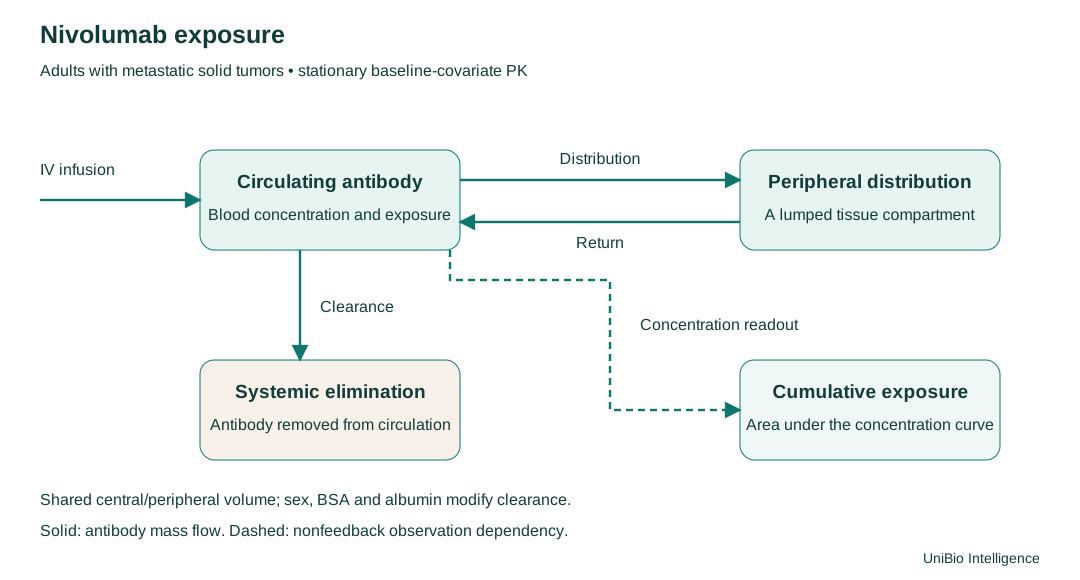
Explore conditional systemic antibody exposure and covariate effects.

Model details

9 parameters · 4 states · 4 equations · 12 derived outputs

Classification & API access
Therapeutic
Nivolumab
Modality
Monoclonal antibody
Target
PD-1 / PDCD1
Disease / scope
Adults with metastatic solid tumors
ParameterDefaultUnitDescription
Serum albuminalbumin_g_l42g/LBaseline serum albumin; denominator 42 g/L.
Albumin power clearancealbumin_power_cl-1.34—Final albumin power on clearance.
Bsabsa_m21.9m²Baseline physical BSA; denominator 1.9 m2.
Bsa power clearancebsa_power_cl0.97—Final BSA power on clearance.
Clearance referencecl_reference_l_day0.211L/dayFinal Table 2 estimated reference clearance.
Female fraction clearancefemale_fraction_cl-0.17—Final fractional female effect on clearance.
Female indicatorfemale_indicator0—Male 0, female 1.
Intercompartmental clearanceq_l_day0.48L/dayFixed 0.02 L/h, converted to 0.48 L/day.
Shared volumeshared_volume_l3.46LOne estimated volume; V1 and V2 are exactly equal.

Related models

Feedback: helpdesk@unibiointelligence.com.

Ubi Biologics