IL-23 dual-epitope equilibrium neutralization
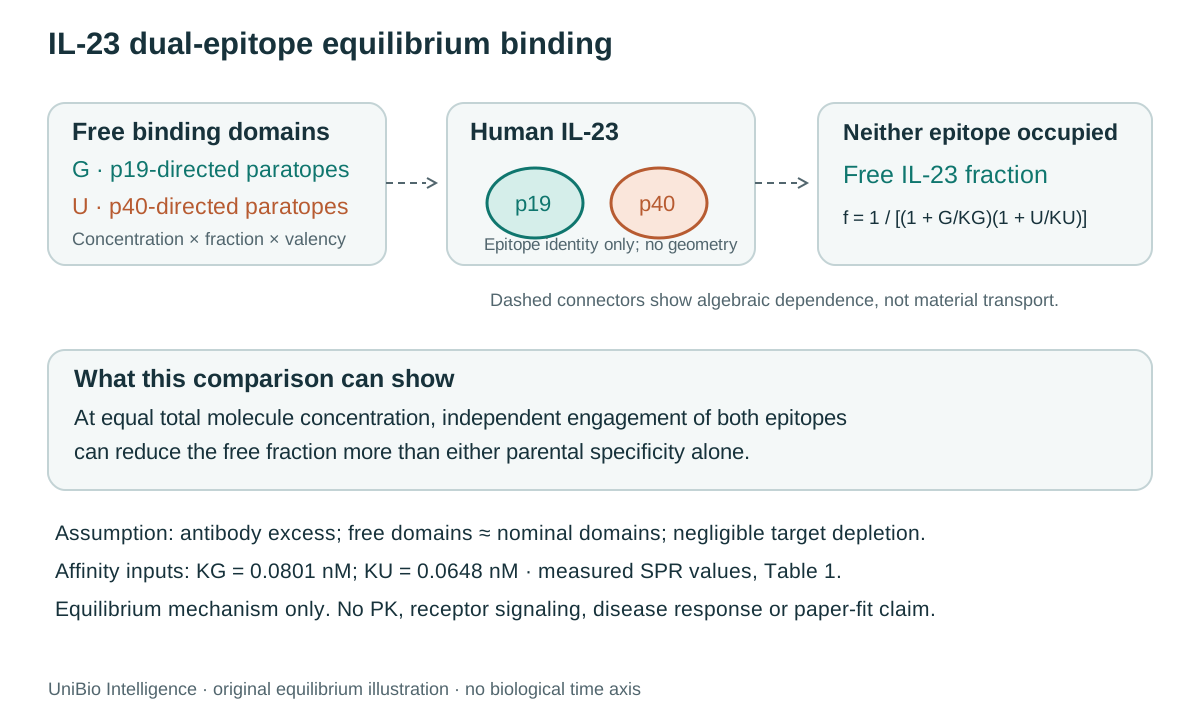
Explore independent engagement of two IL-23 epitopes using measured SPR affinities. Report the equilibrium result only; the relaxation axis has no biological time interpretation. Compare six fixed presets covering the unbound reference, bivalent parental antibodies, their equimolar mixture, and 1+1 or 2+2 dual-epitope formats. Antibody excess and negligible target depletion are assumed; no fitted bioassay, disease, or clinical prediction is made.
Biparatopic targeting of IL-23 enables dual-epitope engagement and enhanced neutralization potency ↗mAbs
Exploration notes · What are you exploring?
Notes stay on this browser.
MODEL IN MOTION 18 sec
How does antibody concentration change free IL-23 under independent dual-epitope engagement?
No-antibody normalized IL-23 baseline
Equilibrium comparison: the chart coordinate is numerical equilibration, not biological time; no kinetic time course is modeled. Baseline no-antibody condition. The local paper source reports IL-23 dose-response curves and EC50 fold shifts, but no machine-readable baseline EC50 table; the runtime keeps baseline_signal_ec50_nM at 1.0 by default.
Inputs changed since the displayed result. Run to update the comparison.
Biology
Explore independent engagement of two IL-23 epitopes using measured SPR affinities. Report the equilibrium result only; the relaxation axis has no biological time interpretation.
Model details
11 parameters · 4 states · 4 equations · 10 derived outputs
Classification & API access
- Therapeutic
- Guselkumab/ustekinumab-derived experimental biparatopic antibodies
- Modality
- Monoclonal antibody
- Target
- IL-23A, p19, IL-12B, p40
- Disease / scope
- Recombinant human IL-23 binding (no disease model)
| Parameter | Default | Unit | Description |
|---|---|---|---|
Gsk guselkumab monovalent il 23 dissociation constantKd_guselkumab_nM | 0.0801 | nM | Affinity of the guselkumab-derived anti-IL-23A/p19 paratope. Converted from pM to nM for runtime concentration units. |
Gsk ustekinumab monovalent il 23 dissociation constantKd_ustekinumab_nM | 0.0648 | nM | Affinity of the ustekinumab-derived anti-IL-12B/p40 paratope. Converted from pM to nM for runtime concentration units. |
Baseline il 23 bioassay EC50baseline_signal_ec50_nM | 1 | nM | Set to a measured no-antibody IL-23 EC50 to convert fold shift into absolute predicted EC50. Default 1.0 makes predicted_ec50_nM equal to fold shift. |
Numerical relaxation rateequilibration_rate | 10 | 1/h | Fast relaxation rate used to embed the paper algebraic equilibrium equations in the ODE engine without changing their steady-state solution. |
Fraction of molecules carrying guselkumab derived paratopeguselkumab_molecule_fraction | 0.5 | — | For bivalent antibody mixtures this is the guselkumab molecule fraction. For 1+1 or 2+2 biparatopic formats use 1.0 because every molecule carries this paratope. |
Guselkumab derived paratope valencyguselkumab_valency | 2 | — | Use 2 for bivalent GSK-Guselkumab or 2+2 bpAb, 1 for 1+1 bpAb, and 0 for no guselkumab-derived paratope. |
Total binding domain dose for optimal ratio calculationoptimization_domain_dose_nM | 6 | nM | Legacy provenance-only input. Optimization now derives the actual binding-domain total from treatment concentration, fractions and valencies; this value does not alter predictions. |
Total target concentrationtarget_total_nM | 1 | nM | Used to report free IL-23 in normalized concentration units. Does not alter the EC50 fold-shift equation. |
Total antibody concentration in neutralization assaytotal_antibody_nM | 3 | nM | Total molecule concentration of antibody treatment. For mixtures, split by molecule fractions; for biparatopic molecules, all molecules carry both paratope classes. |
Fraction of molecules carrying ustekinumab derived paratopeustekinumab_molecule_fraction | 0.5 | — | For bivalent antibody mixtures this is the ustekinumab molecule fraction. For 1+1 or 2+2 biparatopic formats use 1.0 because every molecule carries this paratope. |
Ustekinumab derived paratope valencyustekinumab_valency | 2 | — | Use 2 for bivalent GSK-Ustekinumab or 2+2 bpAb, 1 for 1+1 bpAb, and 0 for no ustekinumab-derived paratope. |
Related models
Feedback: helpdesk@unibiointelligence.com.
