CD11a turnover under fixed efalizumab exposure
Explore CD11a synthesis, free-target degradation and bound-target internalization under a specified constant free-antibody concentration. The concentration is an external input; no antibody PK, dosing history or clinical response is predicted.
Prediction of the Pharmacokinetics, Pharmacodynamics, and Efficacy of a Monoclonal Antibody, Using a Physiologically Based Pharmacokinetic FcRn Model ↗Exploration notes · What are you exploring?
Notes stay on this browser.
No exposure: target equilibrium
How does target turnover preserve its baseline in the absence of antibody exposure? Deterministic exploratory scope.
Biology
Explore CD11a synthesis, free-target degradation and bound-target internalization under a specified constant free-antibody concentration. The concentration is an external input; no antibody PK, dosing history or clinical response is predicted.
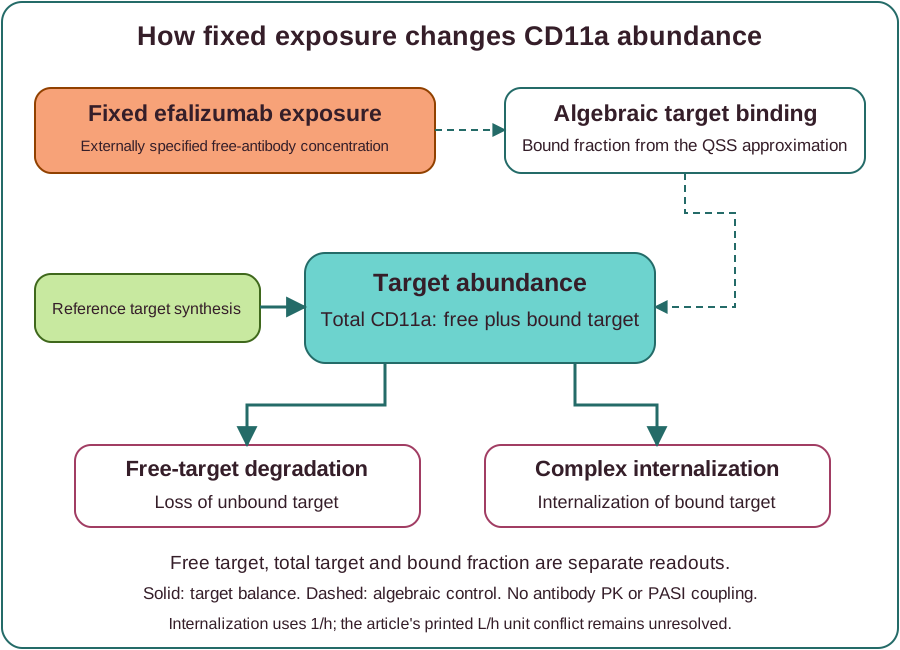
States & equation dependencies
Assumptions & evidence
Assumptions & limitations
- The free-antibody driver is external and constant. The original effect-site matrix and treatment-time exposure histories are unresolved; no antibody PK or dose conversion is executed.
- Baseline target defines synthesis and normalization, while starting target concentrations are explicitly fixed by each scenario. Changing baseline requires coordinated initial-state admission; it is excluded from independent analysis axes in this draft.
- The recovery condition begins from a specified depleted target after exposure removal. It is not a continuously simulated treatment/washout history.
- Complex internalization is interpreted in 1/h for dimensional consistency; the source printed L/h is an unresolved unit conflict.
- The deterministic log-effect is a fixed sensitivity input. Original variability distributions, full PBPK, populations and target-to-PASI coupling remain incomplete.
- Control bounds are independently authored exploratory ranges, not observed covariate ranges or clinical exposure recommendations.
- The initial target and reference target remain fixed by the selected configuration; baseline is not an independent editable control.
- Free and total target percentages are distinct from the algebraic bound fraction. No clinical efficacy or safety prediction is supported.
Parameter origins
- Released executable model definition; exact publication locator not reported
Validation & references
One or more implementation checks are available; this is not a claim of full model reproduction.
Prediction of the Pharmacokinetics, Pharmacodynamics, and Efficacy of a Monoclonal Antibody, Using a Physiologically Based Pharmacokinetic FcRn Model ↗Available reference curves can be added to the plot when their scenario, readout, time and units match.
Model details
7 parameters · 5 states · 5 equations · 6 derived outputs
Classification & API access
- Therapeutic
- Efalizumab
- Modality
- Monoclonal antibody
- Target
- CD11a, ITGAL
- Disease / scope
- Psoriasis (source context; no clinical response prediction)
| Parameter | Default | Unit | Description |
|---|---|---|---|
Qss binding constantbinding_half_concentration | 0.000573 | umol/L | Table 1 Km=(koff+kint)/kon, not the FcRn KD. |
Complex internalizationcomplex_internalization | 0.1 | 1/hour | Table 1 Kint; interpreted first-order rate, printed unit conflict retained. |
Free efalizumab effect site concentrationdriver_ug_ml | 0 | ug/mL | Exploratory external input; no PK prediction or dose conversion is implied. |
Individual log degradation effecteta_target_degradation | 0 | dimensionless | Deterministic log-multiplier, not a recovered source random-effects distribution. |
Drug molecular weightmw_drug | 148841 | g/mol | Table 1 efalizumab molecular weight. |
Drug free target baselinetarget_baseline | 0.01 | umol/L | Table 1 Rmax, estimated by source authors. |
Free target degradationtarget_degradation | 0.0185 | 1/hour | Table 1 Kdeg; reported CV10%. |
Related models
Feedback: helpdesk@unibiointelligence.com.
